

In Aleryos, defending a planet is not only about placing turrets. You must cover two fronts: space, with orbital defenses and your ships, then the ground, with your troops, Iris, and Pillars. Before you are away, the safest reflex remains reducing what an opponent can take.
This guide explains what to build, what each protection covers, and in which order to prepare your planet. For complete rules, consult the planetary defenses wiki.
Telling the two fronts apart
A fleet attack starts a space battle. Your orbital defenses fight there with ships present on the planet. A Pillars attack starts ground combat: orbital turrets do not take part. You must then rely on troops, the Force Field, and Iris.
Iris does not fire in space combat. It can repel a ground incursion before combat, if it is available. One charge is then used and attacking troops return. The ground-combat guide details this second front.
Building useful defenses
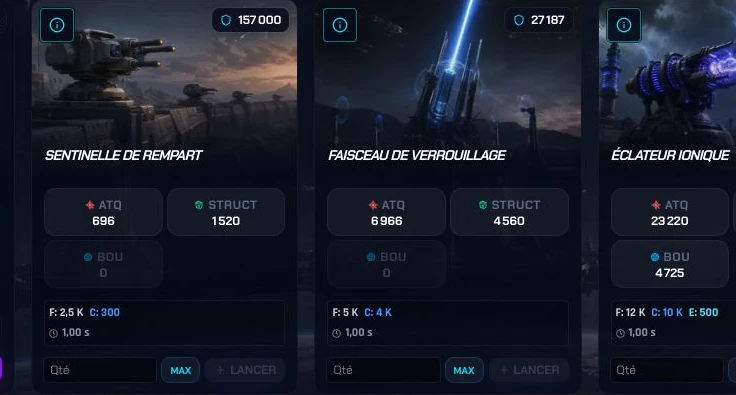
- Rampart Sentinel
- Lock Beam
- Weave Aegis



Defenses do not all have the same role. The Rampart Sentinel is the first curtain of fire. The Lock Beam and Ion Splitter then strengthen the orbital line. The Plasma Forge, Rupture Relay, and Weave Aegis require more advanced research; the Throne Lance and Orbital Bastion arrive later.
| Defense | Main prerequisites | Role to remember |
|---|---|---|
| Rampart Sentinel | Space Yard 3, Weapon Systems 3 | First available orbital defense. |
| Lock Beam | Yard 6, Weapons 6, Laser 4 | Strengthens the defensive line. |
| Ion Splitter | Yard 8, Weapons 8, Ionic 7 | Adds a shield to the defense. |
| Plasma Forge | Yard 10, Weapons 10, Plasma 8, Shields 10, Hull 10 | Can disable an enemy shield. |
| Rupture Relay | Yard 14, Weapons/Plasma/Laser/Shields 12, Energy 14 | Can destroy a hull without an active shield. |
| Weave Aegis | Yard 14, Shields and Energy 14, Hull 10 | Diverts shots away from other defenses. |
| Throne Lance | Yard 16, Weapons/Laser/Energy 15, Hull/Shields 13 | Heavy late-progression defense. |
| Orbital Bastion | Yard 17, Weapons/Shields 15, Plasma 14, Laser 12, Energy 14 | Advanced orbital stronghold. |
Build first what your progression can actually maintain. One large isolated defense replaces neither a well-managed fleet nor a planet prepared before you disconnect.
The Plasma Forge has a 1% chance per shot to disable the shield of the ship hit. The effect starts in the following round and keeps that shield at zero until combat ends. The Rupture Relay can destroy a hull if its shield is zero after the shot. The Weave Aegis diverts up to 100 shots per round away from other defenses; it never protects ships, and only the Monarchs' Cannon and Monarchs' Beam can damage it.
After combat, 90% of destroyed orbital defenses are repaired. They also create far less debris than ships: this often reduces the net loss without making a defense interchangeable with a ship.
Understanding the docked fleet
Defenses can also keep a docked fleet from being committed. If the attack reaches at least four times the combined value of your fleet and defenses, ships at dock are kept out of combat. The threshold drops to three times from 5,000,000 points onward. In that case, defenses fight alone and the report does not reveal your fleet.
Your defenses therefore count in the calculation. But do not treat this rule as a fleetsave: it protects neither resources nor your ships if the threshold is not reached. A committed fleet with an incomplete defending crew fights at 70% of its attack, hull, and shield; orbital defenses keep their statistics.
Your routine before you disconnect
- Send your fleet flying. A fleet in flight cannot be attacked. There is no moon in Aleryos; add a slow ship to adjust the trip to your absence.
- Reduce exposed resources. Spend them, place them in a fleet in flight, or temporarily entrust them to a trusted ally.
- Keep the army safe. An Iris, a deterrent force, or a planet whose Pillars are disabled limits ground risk. Disabling takes one hour and cannot be freely scheduled across the whole empire.
- Use the Force Field when available. It requires active Pillars, protects for 24 hours, then recovers for 48 hours. It blocks a ground attack only when the opposing Virus is not strictly higher than its level.
- Keep useful Sensors. They let you follow incoming fleets. The distant-attacks filter prevents relevant movements from being hidden.
The production sanctuary protects recent natural Iron, Crystal, and Aether production during the first eight hours of inactivity. It begins after about five minutes without interaction; automatic refreshes do not extend that activity. It does not cover stock already present, fleet returns, transports, rewards, queues, or construction. It is a limited safety net, not a reason to leave your resources visible.
Iris, Pillars, and attack limits
If the Force Field refuses a ground attack, no Iris charge is used. If a higher Virus passes through the Field, an available Iris can still repel the attack. Also read the Pillars guide to know when to activate those protections.
Attacks are governed by limits: the point ratio is ×3 in PvP and ×2 against Wanderers. The same player can launch up to three attacks per UTC day over a three-day window, nine at most, before a truce that can last up to two days. Fleet and Pillars attacks count together. The same planet may receive one Pillars attack per UTC day from the same player. Details and exceptions appear in the attack restrictions.
A Resonance Tower can disable some orbital defenses for five minutes. Iris is never affected. This extra risk is a reason to combine defenses, fleet movements, and vigilance instead of relying on one layer alone.
Costly mistakes
Leaving your fleet docked overnight in the hope that turrets will be enough. An attack can arrive quickly and resources remain exposed.
Building orbital defenses to answer a ground threat. Against the Pillars, you need troops, Iris, the Force Field, and the state of your Pillars.
Relying on grouped defense at an ally's planet. A Deployment to another player accepts only recyclers; an alliance helps instead through temporary storage and coordination.
Confusing the sanctuary with stock protection. It hides only recent natural production for a limited time.
If you come from OGame
The fleetsave principle remains familiar: a fleet in flight cannot be attacked. Aleryos adds a ground front. Protecting a planet therefore requires preparing both orbital defense and the rules for Pillars, Iris, and troops.
Frequently asked questions
Which defense should I build first?
The Rampart Sentinel is the first accessible defense, with Space Yard level 3 and Weapon Systems level 3. Then build according to your actual prerequisites and the type of threat.
What is Iris for?
It repels a ground attack through the Pillars before combat. One charge is used and it never takes part in space combat.
Are my destroyed defenses lost?
Not all of them: after combat, the game repairs 90% of destroyed orbital defenses, rounded down. The remaining losses are permanent. Repair does not replace the other protections of your planet.
How do I protect my fleet while I am away?
Send it flying, then reduce exposed resources and army. That is more reliable than leaving all your assets on one planet, even a well-defended one.
For more information: planetary defenses and Iris, keeping your empire safe, and space combat.