
Space combat in Aleryos is a short, random encounter: at most eight rounds, shots distributed among units still present, and a report that then explains every consequence. The built-in simulator compares compositions before you commit a mission; it uses the combat rules, but a simulation remains an estimate, especially when information about the defender is incomplete.
This guide first explains what happens in combat, then how to prepare and read a simulation. To design the devices you send, also consult the ship-model guide.
What fights, and what may stay docked
A space attack can bring together your ships and embarked devices, the fleet present at the defender's location, and its orbital defenses. Devices selected in Embarkation leave their hangars before the first round: they fire, can be targeted, and survive according to their own statistics. If their carrier is lost, they do not disappear with it; the return simply has to find room to embark them again.
Even before the first shot, protection can keep the docked fleet of a human player out of the fight. Below 5 million defender points, the attack's fleet points must reach four times the combined fleet and defense total of the planet. From 5 million points onward, this threshold becomes three times that total. When this protection applies, defenses fight, but the fleet and its crew do not participate, take no damage, and create no debris field.
This rule does not replace defensive preparation. Orbital defenses still fight, and attack, truce, and player-protection rules continue to apply. The combat forces and outcomes wiki details PvP and PvE cases.
Eight rounds to decide combat
Combat has a maximum of eight rounds. At the start of each round, a still-active shield is recalculated from its original value: 100% in round one, then 90%, 80%, down to 30% in round eight. A shield that falls to zero remains broken for the whole combat.
Both sides then fire against the state at the start of the round. A unit destroyed during that round therefore still fires if it was operational when the round began. Combat stops when only one side has units remaining. If both sides survive at the end of the eighth round, or are annihilated in the same round, the result is a draw.
Each weapon produces one shot. A unit with three weapons at 200 attack therefore fires three 200-damage shots, which can hit several targets or focus on one. Shots randomly select a target from enemy units alive at the beginning of the round: there is no automatic priority for the strongest units, defenses, or most fragile ships.
A shot hits shield before hull. Any excess beyond what was needed to destroy the target is not redistributed: the report displays it as overkill. Civilian ships remain valid targets, but they do not fire.
Shield, hull, evasion, and crew
Before taking a hit, a ship can evade. Its cap depends on the chassis and equipment reduces that rate; orbital defenses never evade. A civilian model doubles its base evasion, up to a global cap of 70%, without gaining the right to fire. The wiki page on shots and shields gives chassis caps and the complete formula.
The defender's crew also matters. If at least one role required by the fleet actually committed is missing, all its ships fight with 70% of their attack, hull, and shield. Its defenses, evasion, and firing rate do not receive this penalty. In the simulator, the unknown-crew option assumes a complete crew instead: check this before treating victory as assured.
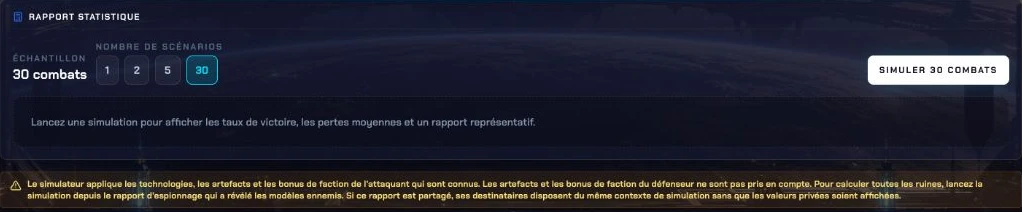
Technologies, artifacts, and certain bonuses modify statistics before combat. The simulator applies the attacker's bonuses when known; the defender's artifacts and faction bonuses are not included. That is another reason to read a result as a risk range, not a promise.
Defenses that change a battle
- Weave Aegis
- Plasma Forge
- Rupture Relay


Orbital defenses do more than add hull points. The Weave Aegis can cover up to 100 shots per round aimed at other defenses. Only the Monarchs' Cannon and Monarchs' Beam can damage it; other shots it receives, including redirected ones, produce neither damage nor critical hits.
The Plasma Forge can, on a shot that hits, disable a shield from the following round. The Rupture Relay can reduce a hull to zero if the target's shield is at zero after that shot. The Pillars Iris does not fight in space: it belongs to ground defense.
After combat, 90% of destroyed defenses are repaired automatically, rounded down. This repair often lowers the net loss without turning a sacrificed defense into a free resource. Roles, prerequisites, and special effects are explained in the planetary defenses wiki.
Losses, loot, debris, and returns
A disabled hull is not always destroyed permanently. For each player model, 15% of disabled units take light damage, 45% take heavy damage, and the rest are destroyed, rounded down. Heavy damage returns or enters dock depending on the side, then goes through repair; the defeated side's lightly damaged units remain in emergency evacuation until manually recalled.
Only permanently destroyed hulls and defenses destroyed during combat create debris. Loot exists only if the attacker wins: it takes 50% of exposed resources, up to the surviving freight capacity. Production still covered by the sanctuary is not exposed to looting. Planning transports or freight capacity is therefore as important as winning the report.
Devices that no longer fit in surviving hangars are not abandoned: they form an emergency return with their crews. The report distinguishes normal return, heavy damage, emergency evacuation, and hangar rescue. If the attacker loses in the first round, its copy of the report hides the defender's details; that does not change the losses actually calculated.
Simulating a space battle step by step
- Open Simulation, then the Space tab. From an espionage report, the simulation button can prefill the revealed information.
- Check your fleet and models, then add your known technologies, artifacts, and faction bonuses. Add an ally only when you are genuinely preparing a group attack with that member and model.
- Describe the defender: ships, defenses, available technologies, exposed resources, and crew status if you know it.
- Choose 1, 2, 5, or 30 scenarios. One scenario shows one possible draw; 2 or 5 provide limited precision. Use 30 when the composition is accepted and you need to compare a real risk.
- Read the victory rates, average losses, survivors, loot, debris, and representative report. That report corresponds to one scenario with the majority outcome; it does not describe every simulated combat.
- If you decide to attack, the button prepares an attack mission with the simulated units. Then check its target, fleet, freight, and Operations conditions before confirming it.
The simulator may refuse some samples when the forces, number of shots, or estimated memory exceed its budget. In that case, reduce the volume or number of scenarios, without concluding that real combat would be impossible.
What espionage actually imports
Espionage advantage determines which information prefills the simulation. Resources are visible from advantage 0; ships and their model statistics from 1; defenses from 2; ground troops and crew from 3; combat technologies from 5. Specialized devices do not appear in an espionage report and are therefore not imported automatically.
A report shared in chat gives its recipients the same simulation context without showing private values. Consult the espionage reports wiki if you need to decide which data are missing before an attack.
If you come from an OGame simulator
Players looking for an OGame combat simulator understandably expect rules compatible with OGame. The simulator presented here is Aleryos's: it calculates this universe's models, defenses, known bonuses, and rules. It therefore makes no promise of compatibility with an OGame report or tool.
Its purpose is to prepare a composition in the same environment as combat, then return to Operations with the simulated units. To watch movements, Aleryos also offers Pillars Hacking, whose report remains a snapshot of movements visible at the time of reading.
Mistakes to avoid before clicking attack
- Drawing a conclusion after one scenario: targeting and evasion remain random.
- Forgetting that the defender's faction bonuses and artifacts are not simulated.
- Ignoring the defender's crew: the unknown option assumes a complete crew.
- Sending a fleet without freight when loot was part of the calculation.
- Confusing a simulation with a launched attack: the prepared mission still has to be checked in Operations.
- Neglecting possible docked-fleet protection and the defenses that remain active.
Frequently asked questions
Does the simulator use space-combat rules?
It replays combat with the engine provided by the game. Its result remains probabilistic and depends on the information entered, especially the defender's bonuses and crew.
How many simulations should I run?
One simulation describes a scenario. To compare an important attack, run 30 scenarios when that choice is available, then read the rates and losses rather than the representative report alone.
Can defenses protect a whole fleet?
Defenses fight, but pre-combat protection can keep a docked fleet out when the point ratio set by the rules is reached. This protection does not remove defenses from the battle.
What happens to damaged ships?
Light damage, heavy damage, and permanent destruction follow different returns. The space-combat consequences wiki details percentages, repairs, and device rescue returns.