
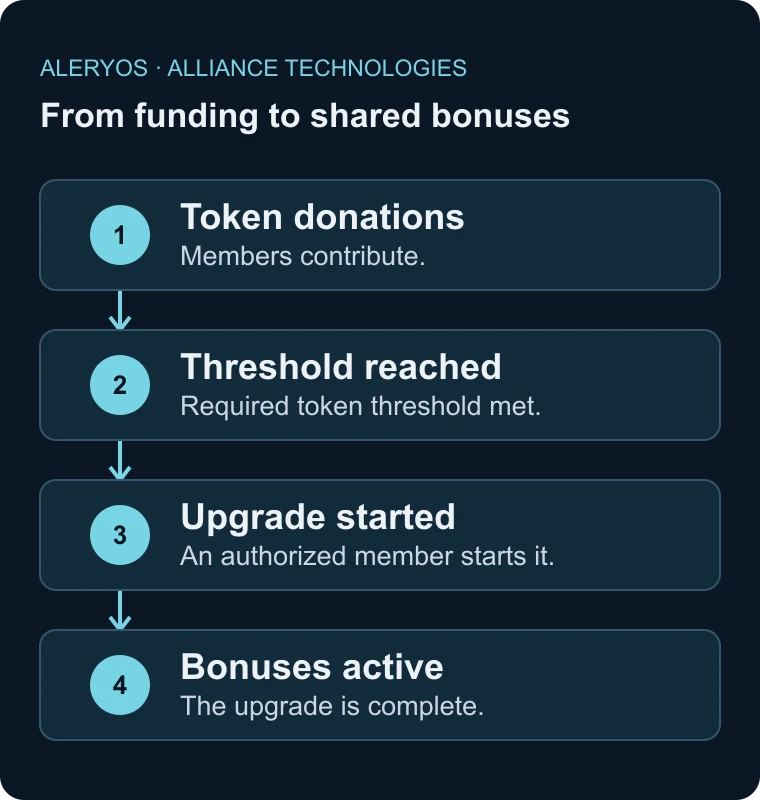
In Aleryos, alliance technologies are funded by member donations of tokens. Reaching the required threshold does not activate a bonus on its own: an authorized member must launch the upgrade, and the bonus takes effect only when that upgrade is complete. Every token could instead support your own empire, so the choice is personal spending tied to a shared, delayed result.
Shared bonuses turn individual spending into a group decision
In a solo decision, you weigh a cost against what it can do for your own empire. With an alliance technology, contributing early means giving up another use for those tokens while the result still depends on the group. A member who waits keeps more room to spend in the short term and may still benefit once the research is complete. That difference can feel unfair, but it does not tell you what constraints or priorities other members are balancing.
The strategic question is not simply which bonus looks strongest. Members also need to agree on what to fund first, how quickly to contribute, and how long they are willing to wait for the result. A useful alliance makes those expectations clear. The bonus matters; so does how the group balances a shared plan against each member’s own development.
Alliances, confederacies, and guilds change different choices
In OGame, the Alliance Combat System (ACS) lets players from the same alliance combine fleets in one attack. Every participating fleet has to reach the target at the same time. That can make a target vulnerable to a force no one member could assemble alone, but it also means the group must plan its timing and coordinate who takes part. An alliance changes what players can attempt together, not just where they can talk.
Travian: Legends draws a sharper line between diplomacy types. Alliance members can share intelligence, resources, and reinforcements. A confederacy can coordinate joint attacks and shared defense, while a Non-Aggression Pact (NAP) is an agreement not to attack; it does not allow resource or troop sharing. The diplomatic label changes what one group can reasonably ask of another.
Forge of Empires calls its groups guilds. In Guild Battlegrounds, guilds compete for provinces that generate victory points, and their performance can move them up or down a league. Cooperation is organized around a recurring territorial contest: contributing helps the guild compete, rather than only advancing one member’s city. These examples show three different roles for group play: combining fleets, defining mutual aid, and pursuing a shared map objective. Our comparison of OGame, Travian, Forge of Empires, and Aleryos looks at how those choices fit into each game’s wider progression.
Mutual aid has a human and organizational cost
Game rules define what members are allowed to do; players still have to agree on how to do it. Who watches for threats? Who suggests a target or resolves a disagreement? How quickly is everyone expected to reply or contribute? These habits may never appear as a visible bonus, but they determine the pace of the group.
Imagine that several OGame members are preparing an ACS attack and one cannot be online at the agreed time. The group must decide whether to delay the attack or proceed with fewer fleets. ACS makes coordination possible; it cannot make everyone’s schedule fit or decide who absorbs the cost of changing the plan. Joint play can also take time away from personal development or extend a rivalry. If roles and expectations stay implicit, helping can become a one-way obligation. A strong alliance distributes the work as deliberately as it distributes power.
In Aleryos, an alliance and a faction answer different questions
An Aleryos alliance organizes relationships between players through membership, ranks, permissions, a discussion channel, diplomacy, pacts, and shared technologies. It gives members common rights and goals, but it does not choose a doctrine for any one empire.
A faction is the doctrine chosen by your empire and shapes its skill tree. The alliance answers “Who do I cooperate with?”; the faction answers “How do I want to develop my empire?” One brings players together; the other guides personal progression. Choosing a faction does not grant every benefit at once: you develop its skills and advance through grades.
Group play is a good fit if you want your choices to matter to other players and are comfortable sharing some control, time, and resources. If you prefer a fully independent pace, a demanding alliance may add friction. Before joining, ask what response time and contribution the group expects, and how it handles absences or departures. Choose for the commitment you want to make, not only for the bonus or rank on display.